
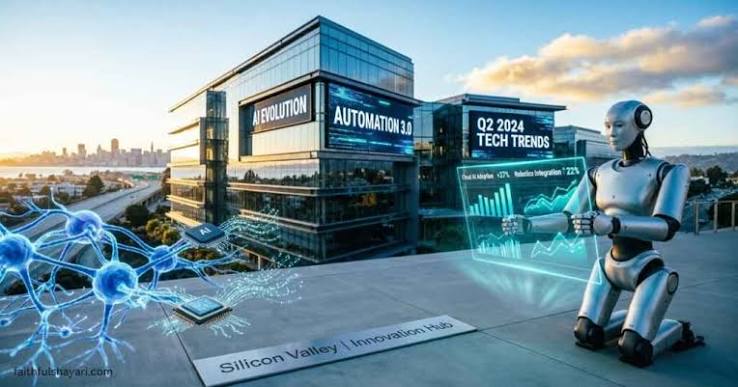
Droven IO tech education trends center on a bigger education shift. AI, practical skills, cloud tools, and flexible learning now matter more.
However, one important distinction is often missed. Public sources do not clearly establish “Droven IO” as a major education platform. Some coverage describes it more accurately as a technology-focused editorial concept.
That changes how this topic should be understood. The useful story is not platform hype. It is the verified education trends behind the keyword.
2026 Trend Snapshot
| Trend | What Is Changing | Why It Matters |
|---|---|---|
| Generative AI | AI assists learning and teaching | Creates new learning possibilities |
| AI literacy | Students learn how AI works | Important workplace skill |
| Skills-first learning | Practical ability gains importance | Connects education with employment |
| Cybersecurity | Security knowledge grows in value | Demand continues rising |
| Cloud learning | Labs move into online environments | Enables remote practical work |
| Authentic assessment | Tasks test applied understanding | Harder to outsource thinking |
| Teacher AI skills | Teachers need AI competence | Better classroom implementation |
| Lifelong learning | Skills need frequent updating | Careers change faster |
| Responsible AI | Privacy and ethics become essential | Protects students and learning |
These directions align with current findings from the OECD Digital Education Outlook 2026 and the World Economic Forum Future of Jobs Report 2025.
What Does “Droven IO Tech Education Trends” Actually Mean?
Online articles use the phrase in different ways. Some present Droven IO like an educational ecosystem. Others describe it as a framework for modern technology learning.
That distinction matters.
One 2026 publication explicitly says Droven IO is better interpreted as a trend-driven framework. It says the term connects AI, automation, cloud computing, and practical skills.
A separate technology-site description identifies Droven.io as an editorial technology website. It describes content covering AI, cybersecurity, software, digital transformation, and future work.
Therefore, claims about proprietary Droven IO classrooms, certifications, or AI tutors need caution. They should not be presented as established facts without primary evidence.
The stronger interpretation is simple: Droven IO tech education trends describe the technologies and learning methods influencing modern digital education.
The Biggest Change Is Not AI — It Is How AI Gets Used
AI dominates education discussions. Yet access to AI alone does not improve learning.
The OECD’s 2026 research makes this distinction especially important. Its review says general-purpose generative AI can improve task performance. However, improved performance does not automatically produce genuine learning gains.
That creates a major change in educational thinking.
The old question was:
“Can students use AI?”
The better question is:
“Does AI usage make students understand more?”
That difference will shape classrooms during 2026.
AI can help explain difficult concepts. It can generate practice questions. It can provide feedback and support lesson preparation.
But students still need to reason independently.
AI Education Reality Check
| AI Use | Possible Benefit | Main Risk |
|---|---|---|
| Personal tutoring | Individual explanations | Incorrect answers |
| Lesson planning | Saves teacher time | Generic material |
| Writing feedback | Faster revision | Overdependence |
| Practice quizzes | Immediate practice | Weak question quality |
| Research assistance | Faster discovery | Fabricated information |
| Translation | Wider accessibility | Context errors |
| Assignment generation | Faster preparation | Reduced originality |
The OECD reports that 37% of lower-secondary teachers used AI for their work in 2024. It also found 57% agreed AI helps write or improve lesson plans. Meanwhile, 72% believed AI could harm academic integrity.
Those numbers reveal the real trend: adoption and concern are growing together.
AI Literacy Is Becoming a Core Skill
Learning technology once meant learning software.
That definition is becoming outdated.
Students increasingly need to understand AI outputs. They must recognize limitations, verify information, protect data, and decide when automation is appropriate.
UNESCO takes a human-centered position on this issue. Its guidance recommends developing AI competencies while protecting human agency, privacy, inclusion, and cultural diversity.
This makes AI literacy broader than prompt writing.
A capable learner should understand:
- how to question an AI-generated answer;
- when independent research remains necessary;
- how personal information should be protected;
- why AI outputs can contain errors;
- how human judgment differs from automation.
That combination may become more valuable than knowing one specific AI product.
Products change quickly. Critical thinking lasts longer.
Tech Education Is Moving Toward Skills With Evidence
Another strong Droven IO education trend concerns employability.
Students increasingly need proof they can perform tasks. Knowing definitions alone provides weak evidence.
The World Economic Forum expects 39% of workers’ existing skill sets to change or become outdated between 2025 and 2030.
Its fastest-growing skill categories include:
- AI and big data;
- networks and cybersecurity;
- technological literacy;
- creative thinking;
- resilience and flexibility;
- curiosity and lifelong learning.
This produces an important education shift.
A cybersecurity learner can build a secure lab.
A programmer can publish a working application.
A data student can analyze a real dataset.
An automation learner can build a working workflow.
The project becomes evidence of competence.
This does not mean degrees are disappearing. Formal education remains valuable across many careers. Instead, practical evidence increasingly complements qualifications.
The Emerging “Learn → Build → Explain” Model
Here is a useful way to interpret current education trends.
Traditional digital learning often follows:
Watch → Read → Quiz → Certificate
A stronger model is emerging:
Learn → Build → Explain → Verify → Improve
This model combines several verified trends.
Students first learn a concept. They then apply it to something practical. Next, they explain their decisions. Finally, they verify results and improve weaknesses.
AI fits inside this process without controlling it.
For example, a student learning Python might use AI for debugging. However, the learner should explain why the corrected code works.
That small difference matters.
It tests understanding rather than output production.
This approach also answers the OECD’s warning that successful AI-assisted task completion does not necessarily equal learning.
Assessment Has to Change Because AI Exists
Traditional homework faces a new problem.
A polished final answer no longer proves who performed the thinking.
Therefore, educators increasingly need assessment methods that reveal the process.
Useful approaches include project demonstrations, oral explanations, live problem-solving, drafts, practical simulations, and reflective analysis.
Instead of asking only:
“What answer did you produce?”
educators can also ask:
“How did you reach it?”
This does not require banning AI.
It requires designing assignments where understanding remains visible.
UNESCO’s guidance specifically identifies assessment and learning outcomes among areas requiring reconsideration as generative AI develops.
Teachers Are Becoming AI Supervisors, Not Just AI Users
Teacher training may become one of 2026’s less glamorous but more important trends.
Educators need more than access to AI.
They need judgment.
Teachers must decide when AI adds educational value. They must identify unreliable outputs. They also need appropriate privacy and academic-integrity practices.
The U.S. Department of Education’s 2025 guidance supports responsible AI uses that can improve education outcomes. It highlights AI and computer-science education, educator professional development, personalized learning, and reduced administrative burdens.
This suggests the teacher’s role is expanding.
Technology does not eliminate the educator.
It creates another system the educator must understand and supervise.
Career-Focused Tech Skills Worth Watching
The employment evidence also provides a useful roadmap.
| Skill Area | Why It Matters | Useful Learning Evidence |
|---|---|---|
| AI & Machine Learning | Fast-growing skill demand | Working AI project |
| Cybersecurity | Growing security requirements | Security lab |
| Data Analysis | Supports business decisions | Data portfolio |
| Cloud Computing | Powers digital infrastructure | Deployed application |
| Automation | Reduces repetitive workflows | Automated process |
| Software Development | Builds digital products | Functional application |
| AI Literacy | Relevant across occupations | Verified AI workflow |
The World Economic Forum ranks AI and big data first among rapidly growing skills. Networks and cybersecurity follow closely. Technological literacy also ranks highly.
The important lesson is not “everyone must become an AI engineer.”
Instead, more occupations will require some level of technological fluency.
Privacy and Responsible AI Cannot Be Optional
Personalization sounds attractive.
It also requires data.
A learning system may process student writing, performance patterns, questions, weaknesses, or behavioral information. That makes privacy part of educational quality.
UNESCO warns that rapidly evolving generative AI can outpace regulation. Its guidance emphasizes data protection, age-appropriate use, ethical validation, and human-centered implementation.
Schools therefore need to ask basic questions before adoption.
Who stores student information?
How long is it retained?
Can users delete it?
Is it used for model training?
Can teachers review automated decisions?
A smart learning system without trustworthy governance remains a risky system.
What Is Hype and What Looks Durable?
Not every education trend deserves equal attention.
| Trend | 2026 Assessment | Reason |
|---|---|---|
| AI-assisted learning | Strong | Already widely adopted |
| AI literacy | Strong | Needed across occupations |
| Skills-based projects | Strong | Shows practical ability |
| Cybersecurity education | Strong | Employer demand supports it |
| Teacher AI training | Strong | Necessary for responsible adoption |
| Cloud labs | Strong | Practical and remotely accessible |
| VR replacing classrooms | Overstated | Useful, but context-dependent |
| AI replacing teachers | Weak claim | Human guidance remains essential |
| Fully automated learning | High risk | Learning needs human judgment |
| Blockchain credentials everywhere | Uncertain | Adoption remains fragmented |
This is where many articles about education technology become misleading. They treat every emerging technology as equally transformative.
Current evidence suggests otherwise.
AI literacy, teacher capability, practical skills, assessment redesign, and responsible technology use appear more consequential than flashy hardware alone.
A Practical Tech-Learning Path for 2026
Students do not need to chase every trending tool.
A more durable path starts with fundamentals.
tage 1 — Digital foundation: Learn computing basics, research methods, online safety, and data literacy.
Stage 2 — AI literacy: Understand prompting, verification, limitations, privacy, and responsible AI usage.
Stage 3 —echnical specialization: Choose programming, data, cybersecurity, cloud computing, or automation.
tage 4 — Practical evidence: Build projects that demonstrate actual ability.
Stage 5 — Human skills: Develop communication, analytical thinking, creativity, and adaptability.
Stage 6 — Continuous updating: Review skills as technologies and employer requirements change.
This approach matches an important labor-market reality. The World Economic Forum expects technological and human capabilities to rise together, not separately.
The Real Meaning of Droven IO Tech Education Trends
Droven IO tech education trends should not be reduced to another list of futuristic classroom gadgets.
The deeper shift concerns how learning gets measured.
Access to information is becoming easier. Producing acceptable-looking answers is becoming easier too. Therefore, education must place greater value on understanding, verification, application, and judgment.
AI can support that process.
It cannot automatically guarantee it.
The strongest 2026 learning model combines technology with human reasoning. Students need practical digital skills, but they also need critical thinking. Teachers need AI tools, but they also need authority over their use.
That is the education trend worth watching.
Frequently Asked Questions
What are Droven IO tech education trends?
The phrase describes emerging digital-learning trends. These include AI, practical skills, automation, cloud learning, and responsible technology use. Public evidence does not clearly establish Droven IO as a major standalone educational platform.
What is the biggest education technology trend in 2026?
Generative AI remains one of the biggest developments. However, responsible implementation and genuine learning outcomes matter more than simple adoption.
Will AI replace teachers?
Current evidence supports AI as an educational assistant rather than automatic teacher replacement. Human guidance remains central to effective learning.
Which technology skills are growing fastest?
AI, big data, cybersecurity, networks, and technological literacy show strong growth expectations.
Why is AI literacy important for students?
Students need skills to evaluate outputs, protect information, detect errors, and use AI responsibly.
Are traditional degrees becoming useless?
No. That claim would be misleading. Practical skills and portfolios increasingly complement formal qualifications rather than universally replacing them.
What should students learn first?
Start with digital fundamentals and critical thinking. Then develop AI literacy and one practical technical specialization.
Final Takeaway
Droven IO tech education trends reflect a shift from consuming information toward proving understanding.
The winning learner will not simply know how to use AI. They will know when to question it, verify it, and work without it.
That may be the most important technology skill of all.
Read more:Beaconsoft Latest Tech Info: What the Platform Really Covers in 2026
